Our story · Giza, Egypt

A rare crop.
A patient practice.

Al-Alamia grows Egyptian dragon fruit with the field close to every decision, from plant selection and crop supervision to harvest specifications for professional buyers.

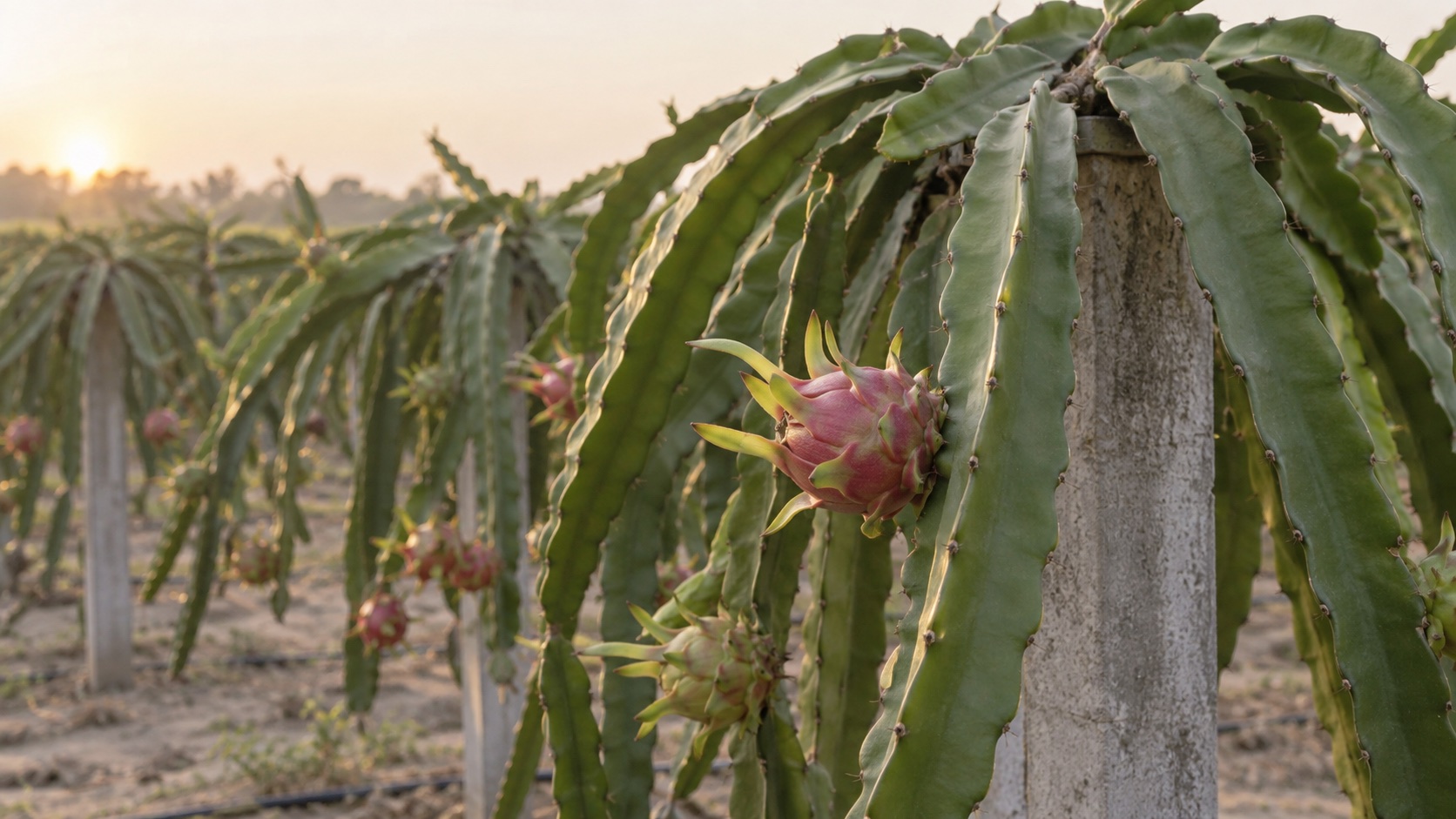
Dragon-fruit cactus branches on support posts in soft dawn light
Dragon-fruit cultivation · Botanical illustration

The people behind the field

Experience that stays
close to the crop.

Our team brings nearly ten years of dragon-fruit experience across private farms, field management, supervision and marketing.

Our agricultural and management team includes Eng. Elewa Mostafa, Dr. Afaf Ayoub and Eng. Sayed Ali, with experience supporting farms in Egypt and work extending to Jordan, Saudi Arabia, Libya, Morocco, Algeria, Tunisia and Benin.

Field knowledge

Agricultural supervision and practical management

Regional experience

Egypt, Arab markets and Benin

The full cycle

Planting material, cultivation, crop care and marketing

Observed & selected in Egypt

EgyM1An Egyptian chapter in the field.

From Vietnamese White
to EgyM1.

Our EgyM1 selection grew out of development work on a Vietnamese White line, selected for higher sweetness and larger fruit. During this work, we recorded sweetness increasing from 12 to 20° Brix and fruit reaching 500–1,000 g in some harvests.

These observations are specific to the selection work, not a specification for every harvest. Fruit size and sweetness vary by season and lot; we confirm actual harvest specifications before quotation.

Explore EgyM1

Know the plant

A tropical cactus.
An Egyptian calendar.

Also known as pitaya, dragon fruit originated in the Americas and belongs to the cactus family. Its oval fruit carries pink or yellow skin, while the seeded flesh may be white, red or purple.

Planting window
March–October
Harvest window
July–November

Cultivation approach

Our cultivation plan includes organic inputs such as vermicompost and horse manure. This describes our planned inputs, not an organic certification.

Light pink peel / White flesh

Mild & refreshing

A widely grown, cultivation-friendly profile.

Deep pink peel / Red or purple flesh

Sweeter & concentrated

A vivid profile for juice and fresh presentation.

Yellow peel / White flesh

Very sweet

A rarer, climate-sensitive type with a rougher skin.

Our long-term cultivation plan

Thinking beyond
a single season.

Our ten-year cultivation model allows for two years of establishment, initial fruit in year three, and mature output from year six. These figures are planning assumptions per feddan (4,200 m²), not production or return guarantees.

Explore our planning assumptions and market context

Production model / per feddan (4,200 m²)

Year 01–02
Establishment
Year 03
4,500 kg
Year 04
6,750–9,000 kg
Year 05
13,500 kg
Year 06–10
18,750 kg

6,000 cuttings per feddan (4,200 m²); cuttings as an additional channel from year three; monthly labour and inputs of EGP 12,000; management and marketing modelled at 15% of production.

Historical market context

Our planning materials cite Mordor Intelligence’s global dragon-fruit market estimate of $14.73B in 2024 and forecast of $18.27B in 2029, with 4.40% forecast annual growth. These historical estimates provide background only; they are not current market figures or an Al-Alamia sales forecast.

Land, establishment, crop prices and return projections depend on land terms, input costs, plant survival, yield, quality and market conditions. This is not a current investment offer.

See the work

The field has its own story.

Visit the field channel

A conversation with the grower

Come closer to the source.

Tell us your market, preferred selection and volume. We’ll start with the available harvest.

Contact Al-Alamia